Earthquake Waves
- Earthquake waves belong to two different families of waves, compression (or longitudinal waves) and transverse waves.
- P waves are compression waves
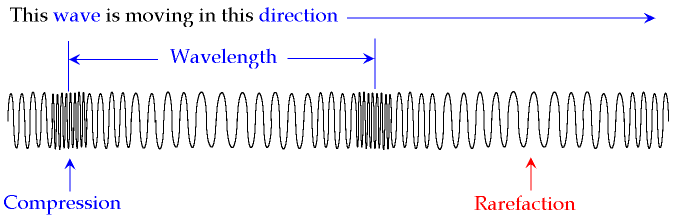
- S and L waves are transverse waves
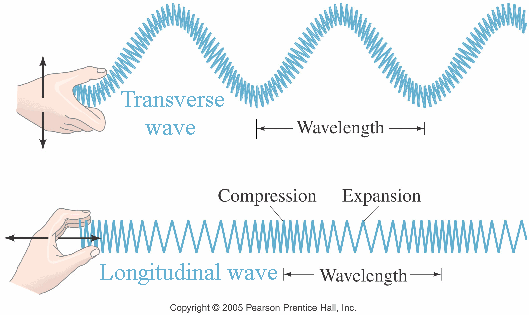

- To understand transverse waves, think of a spring or rope. If the spring is pulled reasonably tight, and you tap down on the spring at one end, then the effect of the tap will travel along the spring. The effect of the tap was to move the coils of the spring up or down (or left to right) a few millimetres. The tension in the spring quickly pulled the coils back into line. However, the first few coils pulled their neighbours out of line so they moved up, then down... and so on. Notice that the tap made the coils move at right angles to the spring while the ripple moved along the spring. The two motions are at right angles to each other. For this reason, we call this a transverse wave.
- As L waves travel along the surface of the Earth, they move the ground from side to side. Any buildings standing on the ground move side to side with it. If the building does not have the strength or flexibility to cope with the movement, it will develop cracks and may even collapse.
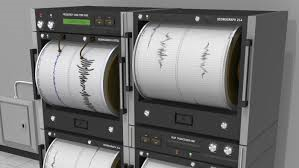
Seismograph, an instrument that measures and records details of earthquakes, such as force and duration.
How we measure earthquakes Richter Scale or Mercalli Scale.?
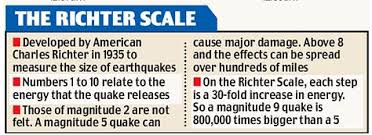
The Richter Scale measures the intensity of the waves.
The Mercalli Scale observes the effects of the L waves.

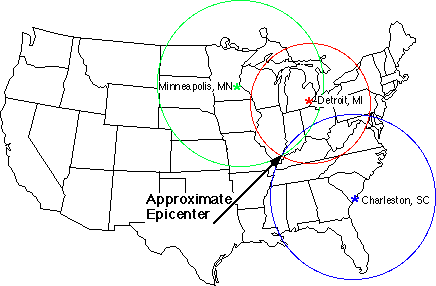
How to calculate the epicentre?
The distance between the beginning of the first P wave and the first S wave tells you how many seconds the waves are apart. This number will be used to tell you how far your seismograph is from the epicentre of the earthquake.